
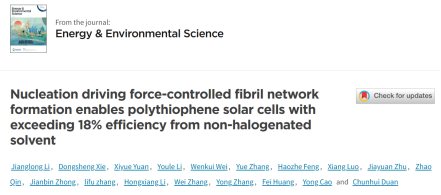
Recently, the research team led by Professor Zhang Yong from the School of Electronic Science and Engineering (School of Microelectronics) at the South China Normal University (SCNU) Engineering Department, in collaboration with partners, has made significant progress in the study of polythiophene-based organic solar cells. The related findings have been published in the internationally renowned academic journal Energy & Environmental Science under the title: "Nucleation driving force-controlled fibril network formation enables polythiophene solar cells with exceeding 18% efficiency from non-halogenated solvent".
The co-first authors of the paper are Jianglong Li, a second-year master's student at our university, Dongsheng Xie, a Ph.D. candidate from South China University of Technology (SCUT), and Xiyue Yuan, a postdoctoral researcher. The corresponding authors are Professor Chunhui Duan from SCUT, Postdoctoral Researcher Xiyue Yuan, and Professor Yong Zhang from SCNU. Our university is a co-affiliated institution of the work.
Polythiophene, with advantages such as simple structure and low synthesis cost, is one of the most promising donor materials for large-scale production of organic solar cells. However, its power conversion efficiency (PCE) has been limited by challenges in optimizing the morphology of the active layer. Although traditional molecular modification strategies have partially improved efficiency, they often increase material complexity and cost. Thus, achieving high-efficiency polythiophene solar cells through morphology control is a key challenge for their commercialization.
To address this, Professor Zhang Yong's team collaborated with Professor Chunhui Duan's team from SCUT. Based on classical nucleation theory, they regulated the solubility of polythiophene by solvent selection to optimize the nucleation driving force. This approach successfully enabled the construction of a refined fibril network morphology in the photoactive layer using the non-halogenated solvent toluene. Halogenated solvents such as chloroform and chlorobenzene, due to their high solubility of P5TCN-HD, resulted in an insufficient nucleation driving force. In contrast, polar solvents like tetrahydrofuran and 2-methyltetrahydrofuran led to excessive crystallization of the acceptor due to their low solubility. On the other hand, non-halogenated solvents such as toluene and o-xylene, with their low solubility, enhanced the nucleation driving force of P5TCN-HD and provided an appropriate nucleation time, thereby promoting the formation of a bicontinuous fibril network.
As a result, the binary device based on toluene-processed P5TCN-HD:eC9-2Cl achieved a PCE of 17.10%, while the ternary device P5TCN-HD:eC9-2Cl:L8-BO-F reached a PCE of 18.12% with a fill factor (FF) of 79.17%, setting new records for both efficiency and fill factor in polythiophene solar cells. This study reveals the critical role of solvent solubility in regulating film formation processes and morphological evolution, providing an important theoretical foundation for the optimization of polythiophene-based devices.
The related research work was supported by funding from the National Natural Science Foundation of China, the Guangdong Basic and Applied Basic Research Foundation, the Guangdong Provincial Innovation Team Research Program, and other scientific research projects.
Professor Zhang Yong, a doctoral supervisor, has published over 40 academic papers, including 30 SCI-indexed papers. His publications include more than 10 papers in international journals such as Advanced Materials, Advanced Functional Materials, Applied Physics Letters, Optics Letters, Chemistry of Materials, and Synthetic Metals. He has applied for 7 invention patents, with 3 already granted, and has led or participated in 10 scientific research projects. He is also a recipient of the Second Prize of the Guangdong Provincial Science and Technology Award.
Link: https://url.scnu.edu.cn/record/view/index.html?key=6b6d7a7163a1b2322a6cd68ce1b18452