
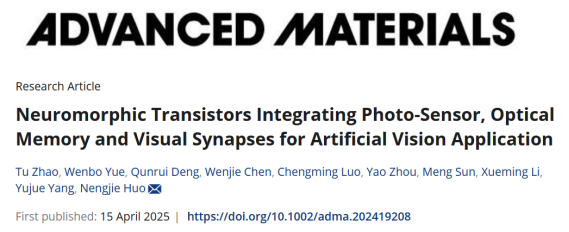
Recently, Researcher Huo Nengjie's team from the School of Electronic Science and Engineering (School of Microelectronics), Faculty of Engineering, South China Normal University, has made breakthrough progress in the field of neuromorphic devices integrating sensing, memory and computing. The related achievement, entitled "Neuromorphic Transistors Integrating Photo-Sensor, Optical Memory and Visual Synapses for Artificial Vision Application," has been published in the top international journal "Advanced Materials" (Q1, IF: 27.4). Zhao Tu and Yue Wenbo, 2022 master's students from the School of Electronic Science and Engineering (School of Microelectronics), are co-first authors of the paper, Researcher Huo Nengjie is the corresponding author, and our university is the first completion unit. Through innovative device architecture design, this research for the first time integrated the three core components of an artificial vision system—optical sensing, optical memory, and visual synapses—into a single transistor, achieving a new device paradigm that integrates sensing, memory and computing, and opening a new path for the development of new-generation intelligent machine vision systems.
Breaking Conventions: Integration of Three Visual System Functions into a Single Device
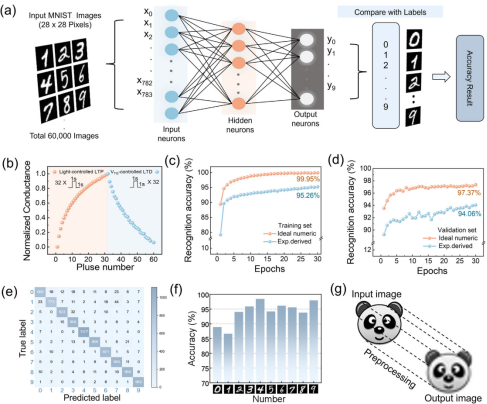
In the human visual system, over 80% of external information is processed through the visual pathway. Traditional artificial vision systems, with their physically separated sensing, memory, and processing units, face challenges such as low energy efficiency, high latency, and poor integration. Inspired by the integrated mechanism of biological vision systems, the research team utilized gate-tunable vertical electric field control technology to achieve intelligent switching among three functional modes within a single device: In the photosensing mode, the device exhibits ultra-high sensitivity, with a responsivity of 6.515 kA W⁻¹ and a specific detectivity of 3.92×10¹⁴ Jones. In the optical memory mode, it demonstrates non-volatile storage capability of over 4 bits, a write/erase ratio of 10⁶, and a data retention time exceeding 10⁴ seconds. In the synaptic mode, the device exhibits neuromorphic computing capabilities, providing a pathway for complex biological learning and flexible synaptic plasticity. By integrating synaptic plasticity with an artificial neural network (ANN), the system achieves image recognition and classification with an accuracy as high as 95.26%.
Application Prospects: A New Era in Intelligent Vision and Neuromorphic Computing
This device breaks through the physically separated "sensing-memory-computing" architecture of existing technologies, enhancing system energy efficiency through functional integration. Its unique reconfigurability and integrated sensing-memory-computing capabilities not only support dynamic switching among photosensing, optical memory, and optical synaptic functions but can also be combined with artificial neural networks to achieve image classification and recognition processing. The device demonstrates significant application potential in fields such as autonomous driving, industrial inspection, and intelligent robotics, providing an innovative solution to overcome the energy efficiency bottlenecks of traditional von Neumann architectures. This research has received sustained support from the National Natural Science Foundation of China, the Natural Science Foundation of Guangdong Province, and the Guangdong Provincial Key Laboratory of Chip and Integration Technology. A patent application has been filed for the related technology.
Link: https://url.scnu.edu.cn/record/view/index.html?key=74d2f5673c37edafc0059891e9e25053